Key takeaways
-
- Strips for binding, piping, waistbands, and loops are small parts that cause big problems when widths drift.
- Cut on the true bias (45 degrees) when a strip must follow a curve, and on the straight grain when it must stay stable.
- Hand-cutting strips with a ruler and rotary blade is slow and uneven at production volume.
- Automatic strip cutters slice a full roll into identical strips in one run, with saved settings for repeat orders.
- New EU textile rules turn every wasted metre into a real cost, not just an annoyance.
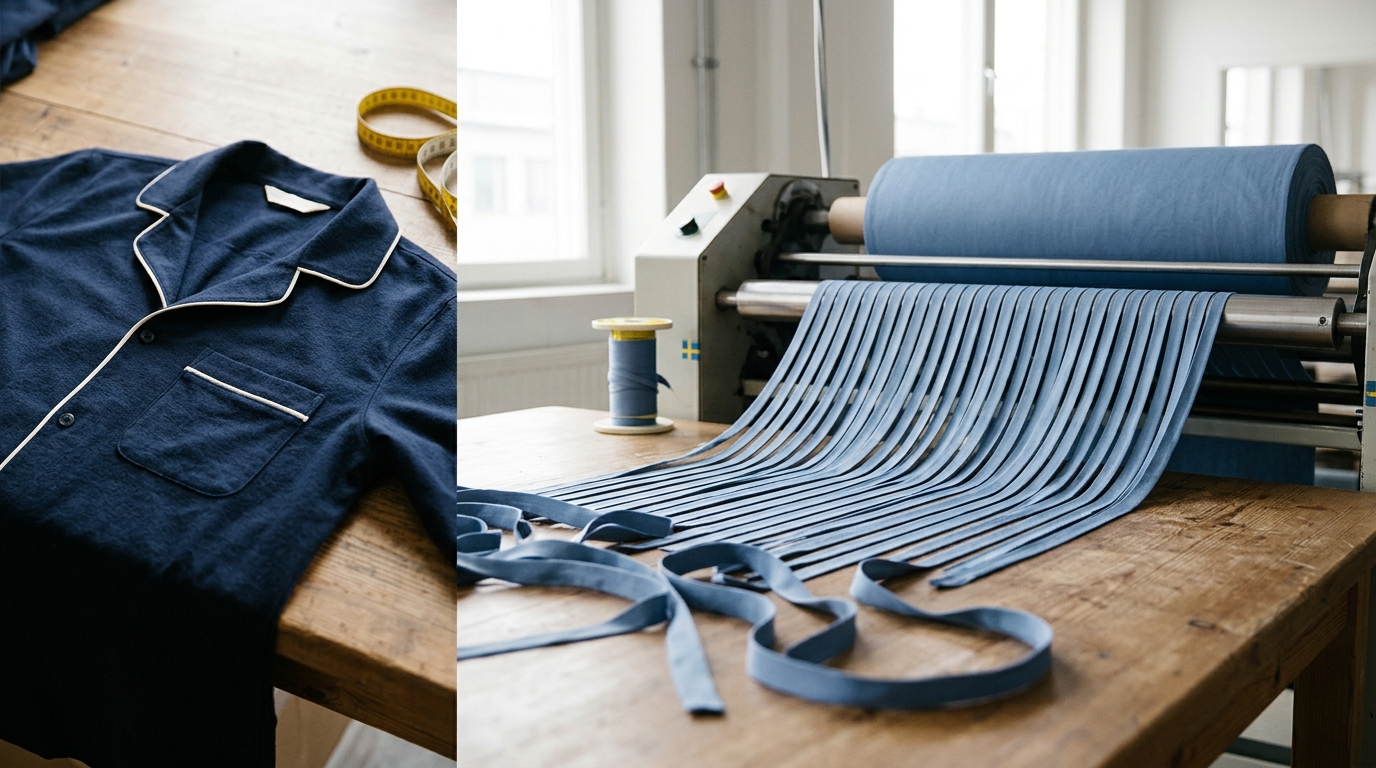
Look closely at this season’s best sellers. A pajama-style shirt with contrast piping. A tailored blazer with a bound inside seam. A jogger with a crisp drawcord channel. The details that make these garments look finished all start as one humble thing: a narrow strip of fabric.
Strips rarely get airtime in a production meeting. Yet they touch almost every garment, and they quietly drain time and fabric when they are cut by hand. So, how do manufacturers cut strips, bindings, and trims faster without wasting fabric? The short answer is this: choose the right grain for the job, then move strip cutting off the table and onto a machine built for it.
Why do strips matter so much in garment production?
A strip is any long, narrow piece of fabric cut to a set width. Strips are used for bias binding on necklines and armholes, piping on pockets and collars, waistband facings, belt loops, drawcord channels, and hanging tapes. One shirt can easily need four or five different strips.
Here is the catch. Small width errors add up fast. A binding that runs 1 mm too wide folds unevenly. A piping strip that wobbles leaves a wavy line along a lapel. Sewing operators then slow down to ease, trim or re-sew, and the cost lands on your margin.
Bias cut or straight grain: which should you choose?
Before any blade touches fabric, the grain decision comes first. True bias sits at a 45-degree angle to the selvage, and it stretches more than either the lengthwise or crosswise grain, which makes it ideal for binding curves, according to the American Sewing Guild. That stretch lets a bias strip hug a round neckline or armhole without puckering.
Straight-grain strips behave differently. They hold their shape and resist stretch, so they suit straight edges such as waistbands, plackets and belt loops. They also use fabric more efficiently, since you cut them straight across the roll with little left over.
A simple rule keeps the team aligned:
- Curves: cut on the bias.
- Straight edges or parts that must not stretch: cut on the straight or cross grain.
- Knits: follow the stretch direction the pattern calls for.
What slows strip cutting down?
Many factories still cut strips with a long ruler, a rotary cutter and a steady hand. For a sample room, that works fine. At production volume, however, it breaks down quickly.
Manual cutting creates three common problems. First, widths drift as the operator tires. Second, every strip needs its own pass, so output depends on headcount rather than equipment. Third, uneven ends on each roll turn into scrap that nobody planned for. As a result, the cutting room becomes a bottleneck for parts that should be the easiest pieces in the garment.
How do automatic strip cutters solve the problem?
An automatic strip cutter takes a full roll of fabric and slices it into many strips of the same width in one continuous process. The operator sets the width, loads the roll and lets the machine handle the repetition. Instead of cutting one strip at a time, the factory cuts a whole roll’s worth in a single run.
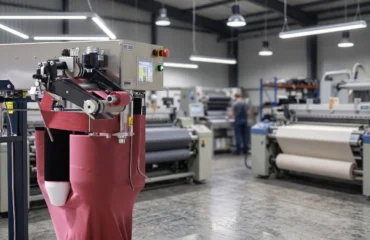
Modern machines add precision on top of speed. Svegea’s FA 500 strip cutter, for example, uses PLC servo controls with an accuracy of ±0.01 mm, stores cutting recipes for repeat orders and sharpens its blade automatically. It handles working widths up to 2,000 mm and cuts open knits, wovens, satin, polyester, PVC, vinyl and non-wovens. Because the housing is fully enclosed, operators stay clear of the blade during every cut.
Recipe storage matters more than it sounds. When a repeat order arrives months later, the team pulls up the saved setting instead of measuring from scratch. That keeps strip widths identical across seasons, and buyers notice that consistency even when shoppers don’t.
Bias strips take a slightly different route. In a bias system, the fabric is first sewn into a tube, then cut in a continuous spiral, producing long bias strips without a join every metre. Meanwhile, knits and stretch fabrics benefit from relaxing before cutting, so the widths you set are the widths you keep.
How does better strip cutting reduce fabric waste?
Most strip waste is created in the margins: uneven roll ends, rejected strips and recuts after a width error. Automatic cutting tightens all three. Consistent widths mean fewer rejects, and saved settings help planners use more of every roll.
That matters well beyond cost. The Ellen MacArthur Foundation estimates that the equivalent of one garbage truck of textiles is landfilled or burned every second. In Europe, the pressure now carries legal weight. The revised Waste Framework Directive, Directive (EU) 2025/1892, entered into force on 16 October 2025 and requires every EU member state to set up extended producer responsibility schemes for textiles, as the European Commission confirms.
The numbers explain why. The EU generates around 12.6 million tonnes of textile waste a year, and less than 1% of textiles worldwide are recycled back into new textiles, according to ERP. Brands that sell into Europe already ask suppliers how they cut waste. The cutting room is one of the easiest places to show real progress.
A quick checklist for faster, cleaner strip cutting
- Decide grain direction at the pattern stage, not on the cutting table.
- Relax knits and stretch fabrics before cutting so widths stay true.
- Standardize strip widths across styles wherever you can.
- Save cutting settings for every repeat style.
- Track strip rejects separately so you can measure the savings.
Frequently asked questions
What is the best way to cut fabric strips in mass production?
Use an automatic strip cutter that slices a full roll into strips of identical width in one run. It is faster and far more consistent than cutting by hand with a ruler and rotary cutter.
Why is bias binding cut at 45 degrees?
The 45-degree true bias gives woven fabric the most stretch. As a result, the strip follows curves like necklines and armholes without puckering.
When should I use straight-grain binding instead of bias?
Choose straight-grain strips for straight edges and parts that must not stretch, such as waistbands and belt loops. They also use less fabric.
Can one strip cutter handle both knits and wovens?
Many can. Heavy-duty models like the FA 500 cut open knits, wovens, satin, polyester, PVC, vinyl, and non-wovens on the same machine.
How accurate are automatic strip cutting machines?
Servo-driven machines can cut to tolerances as tight as ±0.01 mm, which keeps bindings and piping uniform across an entire order.
The finish starts with the strip
The best details in fashion look effortless. Behind them sits a cutting room that gets every strip right, every time. If strips still slow your line down, it may be time to let a machine take over the repetition.
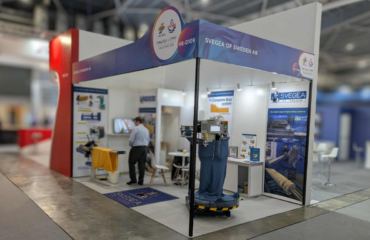
Want to see the FA 500 or Svegea’s bias systems in action? Contact Svegea of Sweden or email Hakan Steene at h.steene@svegea.se to book a product demo.