TL;DR
Single jersey and other technical knits curl and stretch the moment a blade touches them — it’s built into how the fabric is constructed, not a sign something’s broken. The real fix isn’t a slower line or a more attentive operator. It’s tensionless, synchronized feeding that lets the fabric arrive at the blade already relaxed, so the cut reflects the fabric’s true dimensions instead of a stretched, temporary one.
Every cutting room operator working with knits has seen it: the fabric looks fine going into the machine, then the cut edge curls, ripples, or comes out narrower than it should. It’s tempting to blame the operator, the blade, or the line speed. Usually, none of those are the real problem.
Curling Isn’t a Defect. It’s Physics.
Single jersey — the most common weft knit used in T-shirts, base layers, and casualwear — is built from loops, not interlaced threads like a woven fabric. The front face and back face of the loop structure sit under different tension. That imbalance is exactly what makes the fabric curl at a cut or unfinished edge. It’s a documented structural outcome of how the loops are formed, not a flaw in a specific roll of material.
Add tension during cutting, and the problem compounds. Research into how woven and knitted fabrics behave under bias and shear stress shows that fabric under load deforms elastically before it’s even cut. Meaning the shape you’re cutting isn’t the shape the fabric wants to hold once tension releases.
Cut it stretched, and it snaps back distorted the second it relaxes. For rib knits and technical tubular constructions, that snap-back doesn’t just cost a few millimeters of width — it throws off every downstream measurement that depends on that edge being accurate.
Where the Distortion Actually Comes From
Most knit distortion during cutting traces back to one of three points in the process:
- Manual tracking adjustments. An operator nudging the fabric to compensate for drift introduces exactly the kind of uneven pull that causes curling and skewed edges.
- Start-up jerk. The first few seconds of a run — before speed stabilizes — is when fabric gets yanked hardest, and it’s often where the worst distortion shows up.
- Unsupported tension zones. Any point where the fabric isn’t actively guided or supported is a point where it can twist, especially on tubular knits that want to roll along their own axis.
None of these are operator failures. They’re the predictable result of feeding elastic material through a system that isn’t built to account for how elastic material actually behaves.
Fabric under manual tension → cut applied → tension releases → edge curls / narrows / skewsWhat Tensionless, Synchronized Feeding Actually Fixes
The fix isn’t better technique. It’s removing tension from the equation before the blade ever touches the fabric.
Synchronized feeding locks the speed of the fabric source to the speed of the cutting head, ensuring the material moves through the system without pulling or holding back at any point. When you achieve precise synchronization, the fabric reaches the blade in a relaxed state—meaning the blade cuts the fabric’s true, unstressed dimensions. The material never snaps back after you make the cut, because the feed system never stretched it in the first place.
This system delivers the biggest impact on the exact materials that cause the most headaches on a conventional line: single jersey, rib knits, and tubular technical knits, where the fabric’s very construction bakes in tension differences between layers or directions.
Where the Euro-Collarette Series Fits
We built the Euro-Collarette Series specifically around this problem.
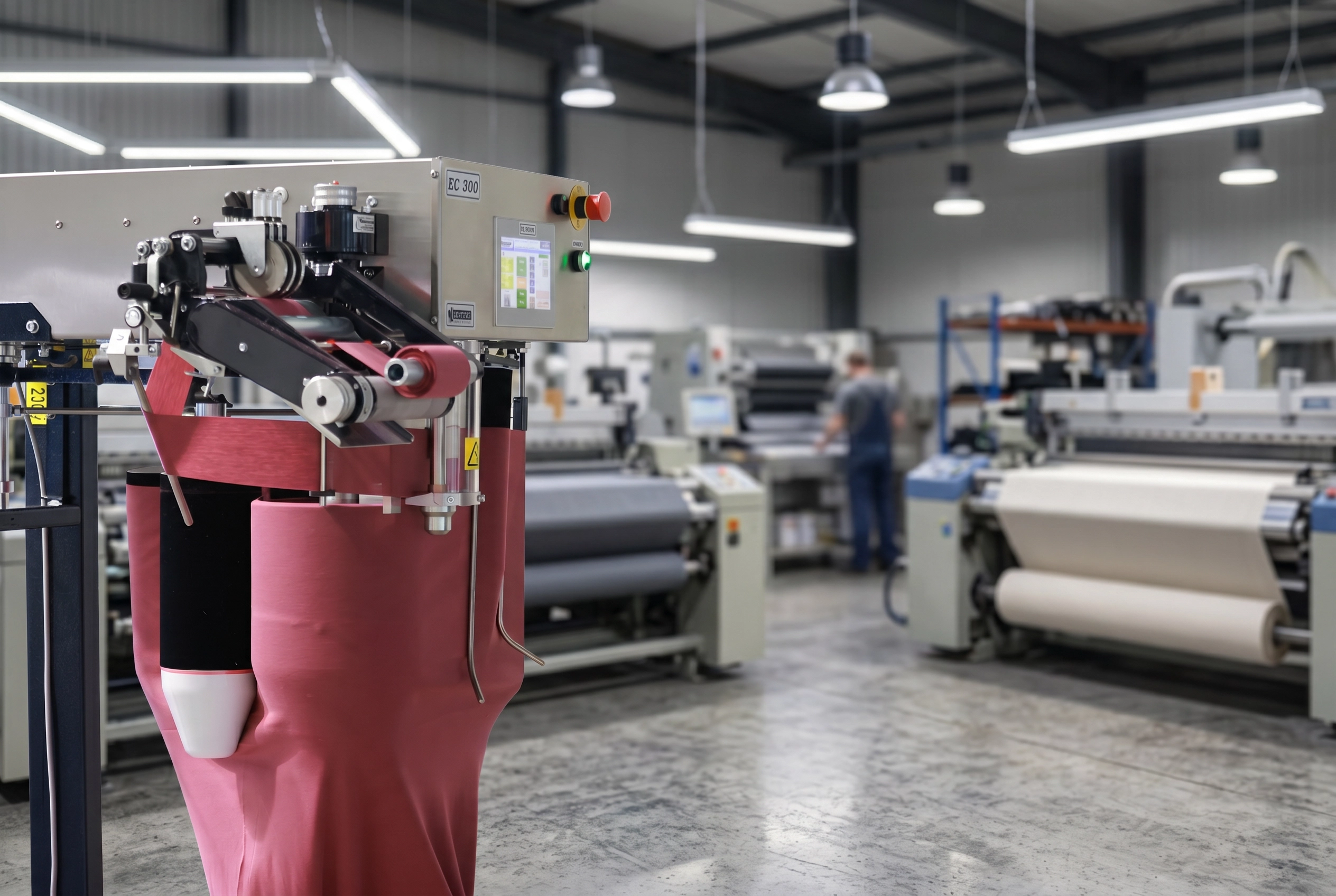
Its electronic soft-start eliminates the initial jerk at the beginning of a run. By bringing the fabric up to cutting speed gradually rather than abruptly, the system prevents distortion right where it usually starts.
We designed the band and fabric guides specifically for technical tubular knits. They support and align the material through the cut, stopping it from twisting or rolling on its own. Pair this layout with variable cutting speeds that adapt to different knit constructions. The machine easily balances the structural differences between a tricky single jersey and a heavy rib knit instead of running everything at a single speed.
You get an edge that holds its true dimension run after run. No operator manual adjustments required.
Why This Matters Before the Sewing Line Ever Sees the Fabric
A distorted edge doesn’t announce itself at the cutting table.
It shows up two or three stations later. A panel that measured perfectly on the cutting log suddenly refuses to align with its counterpart at the sewing machine. By then, the true cost skyrockets far beyond the price of the fabric itself. You’re paying for the labor to catch the defect, pull the ruined panel, and recut a replacement from fresh stock.
Fix the edge early. Getting it right at the cutting stage remains the cheapest place in the entire production chain to solve this problem. Everywhere downstream, that same fix costs more.
See the Euro-Collarette Series in Action
It steals your line speed. It drives up rework and triggers constant assembly rejects. If edge distortion on technical knits is costing your factory time and money, you need to change your process. See how synchronized feeding and precision band guiding handle your fabric differently.
Visit the Euro-Collarette Series page for full specifications. Or reach out to Håkan Steene at h.steene@svegea.se to talk through your specific fabric and production setup.