TL;DR
Cutting rooms routinely lose 10-15% of raw material to scrap, and some estimates run even higher. Active material optimization tackles this head-on. Synchronized feeding, precision fabric cutting, and tight tension control let facilities keep more of the fabric they pay for. The payoff isn’t just a smaller waste pile — it’s fewer downstream rejects and a healthier margin on every roll.
Material costs eat up more than half the total production budget in apparel manufacturing. Yet the cutting room — the single biggest opportunity to control that cost — is still where factories lose the most. Manual layouts, inconsistent tension, and operator guesswork have turned scrap into something everyone accepts.
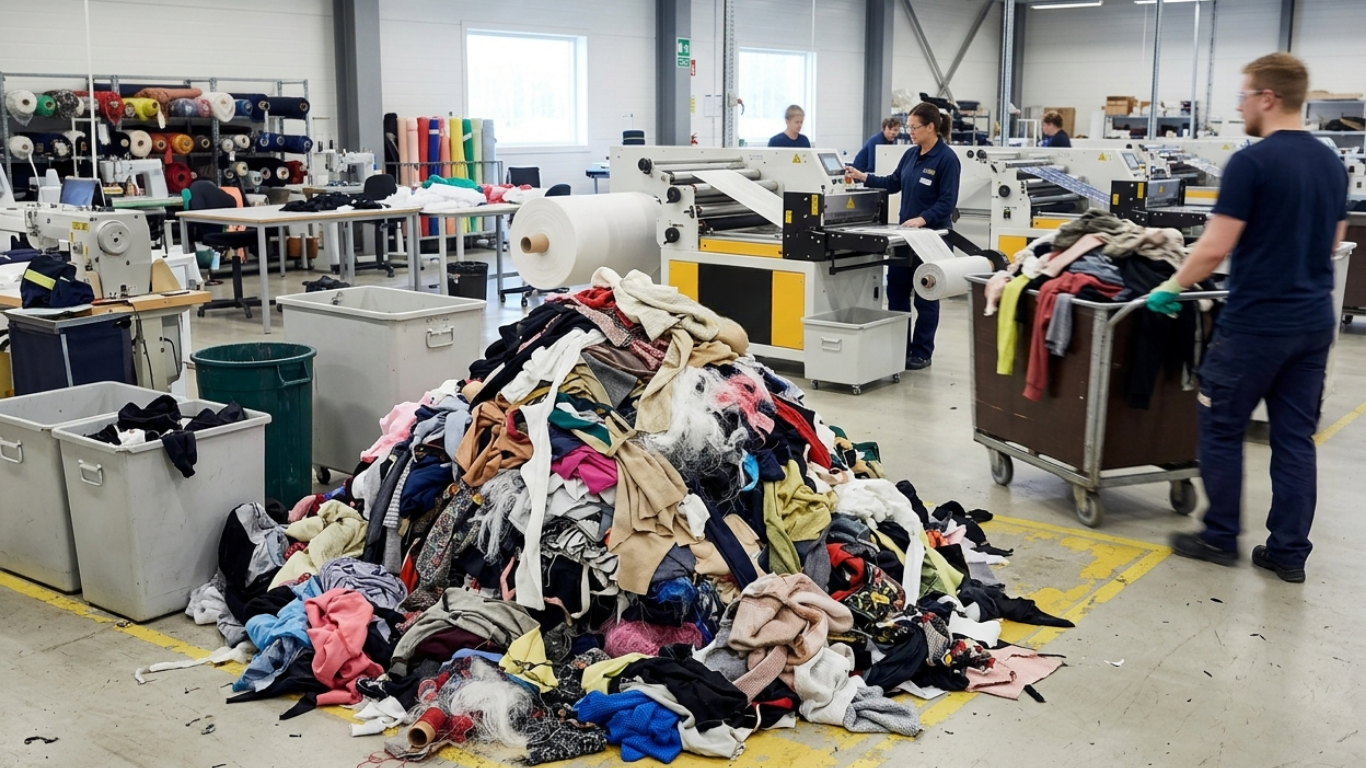
That tolerance is getting harder to justify. Researchers tracking cut-and-sew waste across the apparel supply chain put the number at roughly 10-15% of fabric discarded before it ever becomes a garment. This figure traces back to sustainability researcher Timo Rissanen and has held up across more recent industry reviews. A separate fact sheet on clothing and textile waste puts a similar figure on how much delivered fabric ends up on the cutting room floor (resource.stopwaste.org/fact-sheet/clothing-and-textiles). Multiply either number across a full production run, and the math stops being a rounding error.
Active material optimization is how factories claw that margin back. It pairs automated material handling with precision cutting technology so scrap gets designed out of the process instead of cleaned up after the fact.
What Fabric Scrap Actually Costs You
Every offcut and rejected panel costs a factory twice. First, you’ve already paid for material that never becomes a finished garment. Second, someone still has to handle and dispose of it — that’s labor and disposal fees on top of the wasted fabric itself.
The bigger issue is what bad cutting does further down the line. When tension drifts during cutting, panels warp slightly — not enough to catch in a quick inspection, but enough to pull unevenly once stitched. That mismatch shows up at the sewing stage as a reject, and now you’re paying to recut from fresh stock and eating the labor twice.
What “Active” Optimization Actually Means
Most cutting rooms run reactively: feed the roll in, let the operator adjust for wrinkles or tension shifts as they show up. Active material optimization flips that. Instead of reacting to problems after they appear, automated systems monitor and stabilize the material continuously through the cut.
Getting there means controlling three things at once:
- Mechanical alignment — keeping material square (or precisely on the bias) relative to the blade
- Tension control — preventing the stretch or compression that rollers introduce as fabric moves through the line
- Dimensional consistency — the same component width from the first meter of a roll to the last
Nail these three, and you can tighten margins between components, compress nesting layouts, and cut wide-trim waste dramatically.
Synchronized Feeding: Where Tension Control Actually Happens
Knitted and elastic fabrics are the hardest to get right. They stretch under the slightest pull, and if a blade cuts fabric while it’s under tension, the material snaps back to its relaxed shape the moment it’s released — and that snap-back is where dimensional errors come from.
Fabric under tension → cut applied → fabric relaxes → dimensional inaccuracy / scrap
Synchronized feeding solves this by locking the speed of the fabric source — a turntable, a roll support — to the speed of the cutting head itself. Svegea’s True-Drive II system, for example, uses electronic synchronization to remove physical pull on the material entirely, so fabric reaches the blade already relaxed. Cut on true dimensions instead of stretched ones, and the downstream warping that ruins components simply doesn’t happen.
Precision Fabric Cutting, By Machine Design
High-yield cutting machinery is the most direct lever a factory has for pulling waste out of the cutting room. It replaces manual guesswork with mechanical consistency.
The Svegea CMS 1800A2 Strip Cutter is a good example of what that looks like in practice — a PLC-controlled knife carriage paired with an integrated dust grinding unit, holding tight tolerances across a working width of up to 1650 mm. That consistency is what lets a machine extract more usable product from every roll, run after run.
The Svegea Euro-Collarette Series solves a related but different problem: guiding technical tubular knits, single jersey, and rib fabrics through variable cutting speeds without distortion. Its electronic soft-start eliminates the jerking motion that typically wastes fabric in the first few seconds of a run — a small detail, but one that adds up over hundreds of production cycles.
Traditional workflow:  manual feed → tension shifts → inconsistent widths → high scrap rate
Optimized workflow:    synchronized feed → controlled tension → precision cut → minimal waste margin
Waste Reduction Has to Live in the Workflow, Not Just the Machine
New equipment only gets you halfway. The other half is how the floor actually operates day to day, especially when dimensions change between orders.
In a lot of factories, changing cut dimensions still means stopping the line, manually adjusting blades, and running test cuts until the new size checks out — burning both time and fabric in the process. Flexible cutting systems with tool-free width adjustment and precise mechanical scales cut that changeover down to minutes, and the first cut of a new run comes out usable instead of scrap. That matters most for smaller, custom orders, where setup waste can otherwise eat the whole job’s margin.
Keeping It Working: A Few Habits Worth Building In
Optimization isn’t a one-time upgrade — it holds up better with a bit of ongoing discipline:
- Run a waste audit. Track scrap weight per shift against total fabric used to find where losses actually concentrate.
- Trace downstream rejects back to their source. When a sewn component gets rejected for distortion, follow it back to the original cutting or tension issue.
- Calibrate on a schedule. Blades and synchronization sensors drift over long runs — a routine maintenance schedule catches that before it shows up as scrap.
None of this is glamorous work, but it’s the difference between a cutting room that quietly bleeds margin and one that doesn’t.
Optimize Your Textile Cutting Efficiency
Curious how precision Swedish engineering could tighten up your cutting room, stabilize material tension, and cut fabric waste? For technical guidance, machinery specs, or a conversation about your production layout, reach out to Håkan Steene at h.steene@svegea.se or visit svegea.se.