Not every factory needs full automation — and staying semi-manual has a real cost too. Semi-automatic slitting machines suit smaller runs, mixed fabrics, and factories scaling up gradually. Fully automatic machines are built for high-volume, single-fabric production where consistency is non-negotiable. The right choice comes down to your throughput target, fabric mix, and 3-year growth plan.
Walk into almost any garment or textile factory, and you will find a slitting machine somewhere on the floor. It is one of the most fundamental pieces of equipment in fabric processing — and yet, choosing the wrong type can quietly drain your margins for years.
The debate between semi-automatic and fully automatic slitting machines is not new. But it remains one of the most consequential decisions a production manager will make. Get it right, and your cutting room runs like clockwork. Get it wrong, and you are either over-investing in capacity you do not need or constantly fighting inconsistency and bottlenecks you should have engineered out.
This guide breaks it down — practically, not theoretically — so you can make the call with confidence.
What Is a Slitting Machine, and Why Does It Matter?
A slitting machine cuts wide rolls of fabric into narrower widths — strips, rolls, or lengths — as a primary step before sewing, binding, or finishing. The textile and apparel industry depends on this process more than most people outside manufacturing realize. Slitting accuracy directly affects downstream quality: a blade drift of even 1–2mm compounds into significant inconsistency across thousands of cuts.
There are two broad categories of slitting machines: semi-automatic and fully automatic. Each serves a different production profile. Understanding the difference — not just in spec sheets, but in real factory economics — is where this decision gets interesting.
Semi-Automatic Slitting Machines: The Case for Controlled Flexibility
Semi-automatic slitting machines require operator involvement at key stages — loading rolls, adjusting settings, monitoring tension, and sometimes initiating cuts manually. That involvement is not necessarily a weakness. In the right context, it is exactly what a factory needs.
When semi-automatic slitting makes sense:
- Smaller or mixed production runs. If your factory processes a wide range of fabric types — from lightweight wovens to heavy knits — a semi-automatic machine gives operators the flexibility to adjust on the fly.
- Scaling operations. For factories in a growth phase, semi-automatic machines offer a lower entry cost and a shorter learning curve, while still delivering solid output quality.
- Specialty or technical fabrics. Delicate or coated materials sometimes require human judgment that fully automatic systems are not calibrated for.
- Budget-conscious upgrades. When capital expenditure is constrained, semi-automatic machines deliver meaningful efficiency gains without the premium price tag of full automation.
The trade-off is consistency at scale. When operator skill and attention are variables, output quality becomes a variable too. That is manageable in smaller operations. In high-volume production, it becomes a liability.
Fully Automatic Slitting Machines: The Case for Non-Negotiable Consistency
Fully automatic slitting machines handle the entire process — roll feeding, tension control, cutting, and roll change — with minimal operator input. The operator sets the parameters; the machine executes them every time, without deviation.
This is not just about speed. It is about removing the human variable from a process that demands precision.
When fully automatic slitting is the right call:
- High-volume, single-fabric production. If you are running the same material at scale, full automation delivers consistent output from the first cut to the ten-thousandth.
- Quality-critical applications. Bias binding tape, collarette cutting, and technical textile strips demand roll-to-roll consistency that only automated tension control can reliably provide.
- Multi-shift operations. A fully automatic machine performs identically at 6 AM and midnight. Operator fatigue and shift changes do not affect output quality.
- Long-term ROI targets. The higher upfront investment pays for itself through reduced waste, lower rework rates, and higher throughput. Most factories see full ROI within 12–18 months.
According to McKinsey & Company, automation in the textile and apparel sector consistently reduces production costs by 10–30% when implemented at the right process stages. Slitting is one of those stages.
| Quick Decision Framework
Choose semi-automatic if: your runs are varied, your volumes are moderate, or you are in a growth phase with a tighter capex budget. Choose fully automatic if: you run high volumes of consistent fabric, operate multiple shifts, and want to engineer operator variability out of your quality equation. |
The Real Cost of Getting This Decision Wrong
Here is the part most equipment comparisons skip: the cost of the wrong choice.
Buying a fully automatic slitting machine for a low-volume, mixed-fabric operation means investing in a capability you cannot utilise. Your ROI timeline stretches. Your operators may find the system too rigid for your production reality.
But staying semi-manual when your volumes and consistency requirements have outgrown the format is equally costly — just less visible. Fabric waste accumulates. Rework piles up. Quality holds from your sewing line trace back to inconsistent slitting. The cost is real; it is just distributed across hundreds of small decisions rather than one large invoice.
The International Textile Manufacturers Federation notes that fabric waste accounts for 15–25% of raw material costs in the average garment factory. A meaningful portion of that waste originates in the cutting room — and slitting inconsistency is a primary driver.
A Machine Worth Knowing: Svegea’s Strip Cutter FA 500
Without making this a product pitch, it is worth pointing to a concrete example of what the fully automatic category looks like in practice.
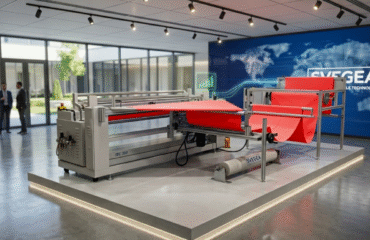
Svegea of Sweden’s Strip Cutter FA 500 is a heavy-duty, fully automatic roll-slitting machine built to handle open knits, woven fabric, PVC, vinyl, satin, polyester, paper products, and non-wovens. It is designed for factories that need to process high volumes of varied materials without sacrificing cut accuracy.
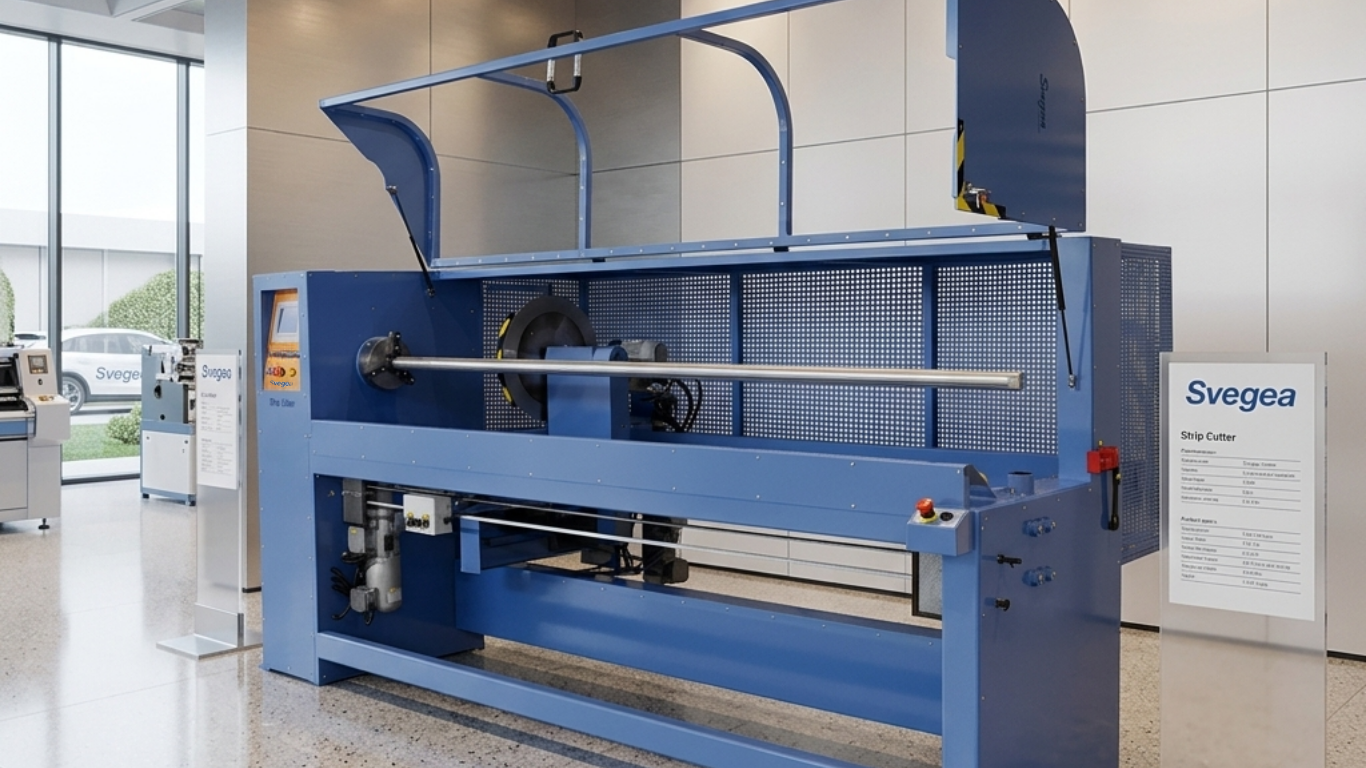
For factories still in the semi-automatic tier, Svegea’s SC 300 and SC 400 Strip Cutters offer the same build quality and material versatility at a more accessible investment level.
The point is not the brand — it is the principle. The best slitting machine for your factory is the one that matches your production reality, not the one with the longest specification list.
How to Make the Decision: A Practical Checklist
Before you invest, work through these questions honestly:
- What is your current monthly output volume? Factories producing over 8,000–10,000 rolls per month typically benefit most from full automation.
- How varied is your fabric mix? More variety = more cases for semi-automatic flexibility.
- How many shifts do you run? Multi-shift operations amplify the consistency advantages of full automation.
- What is your current fabric waste rate? If it exceeds 12–15%, slitting inconsistency may be a contributor — and automation will address it.
- What is your 3-year growth projection? Buy for where you will be, not just where you are.
The Bottom Line
The slitting machine question does not have a universal answer. Both semi-automatic and fully automatic systems have earned their place in textile manufacturing, just in different contexts.
Semi-automatic machines give you flexibility, lower entry cost, and solid performance for operations that are not yet running at scale. Fully automatic machines give you consistency, throughput, and the kind of precision that compounds into real margin improvement over time.
The right answer is the one that matches your throughput target, fabric mix, and growth plan. Everything else is secondary.
Do the audit. Run the numbers. And decide with your next three years in mind, not just your next three months.
| Have questions about which slitting machine fits your factory?
Reach out to Håkan Steene at Svegea of Sweden for a no-obligation consultation. Håkan works with garment and textile manufacturers across 80+ countries to match the right machinery to the right production context. Email: h.steene@svegea.se |
References: WTO Merchandise Trade Statistics | McKinsey — Automation in Fashion | International Textile Manufacturers Federation (ITMF) | Svegea Roll Slitting Machines