Circular knitting machines produce fabric as a seamless tube. What happens after that is a decision every knit manufacturer makes, sometimes without thinking too hard about it: keep the fabric in tubular form or slit it open and process it flat. Both routes are common, and both work. But they don’t behave the same way on the cutting floor, and the choice affects waste, tension, and finish quality more than a lot of production teams realize.
TL;DR: Circular knitting produces fabric as a continuous tube, and manufacturers either keep it that way (tubular processing) or slit it open into a flat sheet (open-width, or flat-bed, processing). Tubular is faster and cheaper but more prone to edge creasing; open width gives better width utilization and finish quality, but the slitting step itself can introduce stretch and distortion. Which one fits depends on the product and how the fabric will be cut.
What Tubular and Open-Width Actually Mean
A circular knitting machine forms fabric on a rotating cylinder of needles, which produces a continuous tube rather than a flat sheet. According to Textile Blog, the width of that tube is half the width the fabric would measure if it were slit open and laid flat, since the machine is knitting both the front and back layers at once. Tubular processing keeps the fabric in that closed-loop form all the way through finishing. Open-width, sometimes called flat-bed or cut-edge processing, slits the tube along one edge early in finishing and processes the fabric as a single flat layer from that point on.
Why Manufacturers Keep Fabric Tubular
Tubular processing has been the traditional route for a reason. It runs faster through finishing equipment, needs less investment in machinery, and works for a wide range of fiber types without extra steps like sizing. It is also the natural form for anything that will end up as a tube in the garment itself, like a T-shirt body or a sock, since there’s no seam to add later.
The trade-off shows up in finishing. Tubular fabric is run through extraction rollers as a folded, double layer. Cotton Incorporated’s processing guidance notes that this makes tubular fabric sensitive to sharp edge lines and creasing where the fold sits, unless roller hardness is matched carefully to the fabric.
Why Manufacturers Move to Open-Width
As quality expectations rose, particularly for elastane-blend fabrics used in fitted garments, more knit processing shifted toward open-width finishing. Academic surveys of the industry point to open-width routes giving more consistent, higher-grade finishing results than tubular processing, which is part of why open-width has been gaining ground even though it typically costs more to run.
Open-width also makes better use of the full fabric surface once cutting starts. A flat sheet lets a marker (the layout of pattern pieces) use the entire width efficiently. It matters more on styles with larger, irregular pattern pieces than it does on narrow trims or bindings. Dyeing and heat-setting can also run more evenly on a flat, single layer than on a folded tube, where the inner and outer layers don’t always receive identical heat or dye exposure.
The Trade-off That Matters Most: What Slitting Does to the Fabric
Here is the part that gets missed most often. Converting tubular fabric to open width means slitting it, and that step is not neutral. Cotton Incorporated’s own guidance is direct about it. For open-width fabrics, the slitter can be a major source of linear stretch or distortion. This is on top of whatever tension the fabric already picked up earlier in finishing. In other words, the act of going from tubular to open width is itself a common point where bowing and skewing get introduced or made worse.
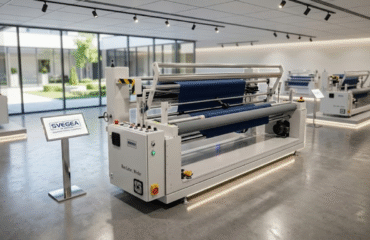
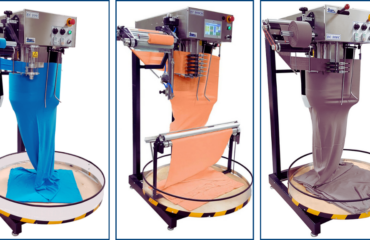
This is where equipment choice starts to matter. A conventional slit-and-flatten process pulls the tube open under tension and typically produces two separate rolls of open-knit fabric from one tube. Svegea’s TSO 380 G/GF Tubular Knit Slitter can convert a tubular knit into a single, full-width roll in one pass. This machine has electronic tension control on the fabric take-up. The main benefit is fabric yield rather than distortion control on its own, but tighter, more consistent tension through the conversion step also means less of the stretch that a rougher slitting process tends to introduce.
Which One Fits Your Line?
There isn’t a universal answer, and the right route usually comes down to questions. What the fabric becomes (a tubular garment part, or flat-cut panels). Or how much elastane or stretch fiber is in the blend. And how much of the fabric width the pattern pieces actually use. Narrow trims, bindings, and bands cut from tubular knit often stay tubular right up to the cutting stage. For high-stretch knit fabrics, larger flat-cut panels frequently justify the additional step of open-width conversion. It also provides slitting automation and tension-free feeding systems used to prevent lateral deformation and edge curl.
It is also worth asking the question per style rather than settling on one route for the whole line. A manufacturer running both fitted, flat-cut garments and simple tubular pieces in the same facility often gets better results.
Need help optimizing your fabric or reducing waste? Contact Håkan Steene: h.steene@svegea.se.