Key takeaways
- Inspect fabric before spreading, when a defect still costs a few metres instead of a finished garment.
- Manual inspection runs at roughly 5 to 12 metres per minute, so variable speed matters more than top speed.
- The features that count most are speed control, edge alignment, tension control, an accurate counter and the right working width.
- A metre counter turns every inspection into a free length check, so short rolls are caught before invoices are paid.
- Most garment factories grade defects with the 4-point system, scored per 100 square yards.
Next season’s orders look different. Brands want smaller runs, more colourways and faster delivery, so every roll has less room for error. One hidden hole or shade band can turn a perfect cut into a rejected bundle.
So what should a factory look for in a fabric inspection machine? In short: adjustable speed, steady tension, straight edges, an accurate length counter and a working width that matches your widest fabric. Get those five right, and inspection becomes a quick daily routine instead of a bottleneck.
Why inspect fabric before it reaches the cutting table?
A defect costs the least when you catch it on the roll. Once fabric is spread and cut, the same flaw also wastes cutting time, sewing time and trims. That is why quality advisers recommend inspecting fabric on a machine before spreading, so flaws show up clearly and only approved rolls reach production, as V-Trust explains.
Inspection protects your supplier relationships too. A clear record of what you found, roll by roll, makes claims faster and far less personal.
It is also one of the easiest places to start improving the whole floor. As we covered in our guide to garment manufacturing efficiency, a good inspection line stops faults before they travel into sewing and finishing, where they cost far more to fix.
How fast should a fabric inspection machine run?
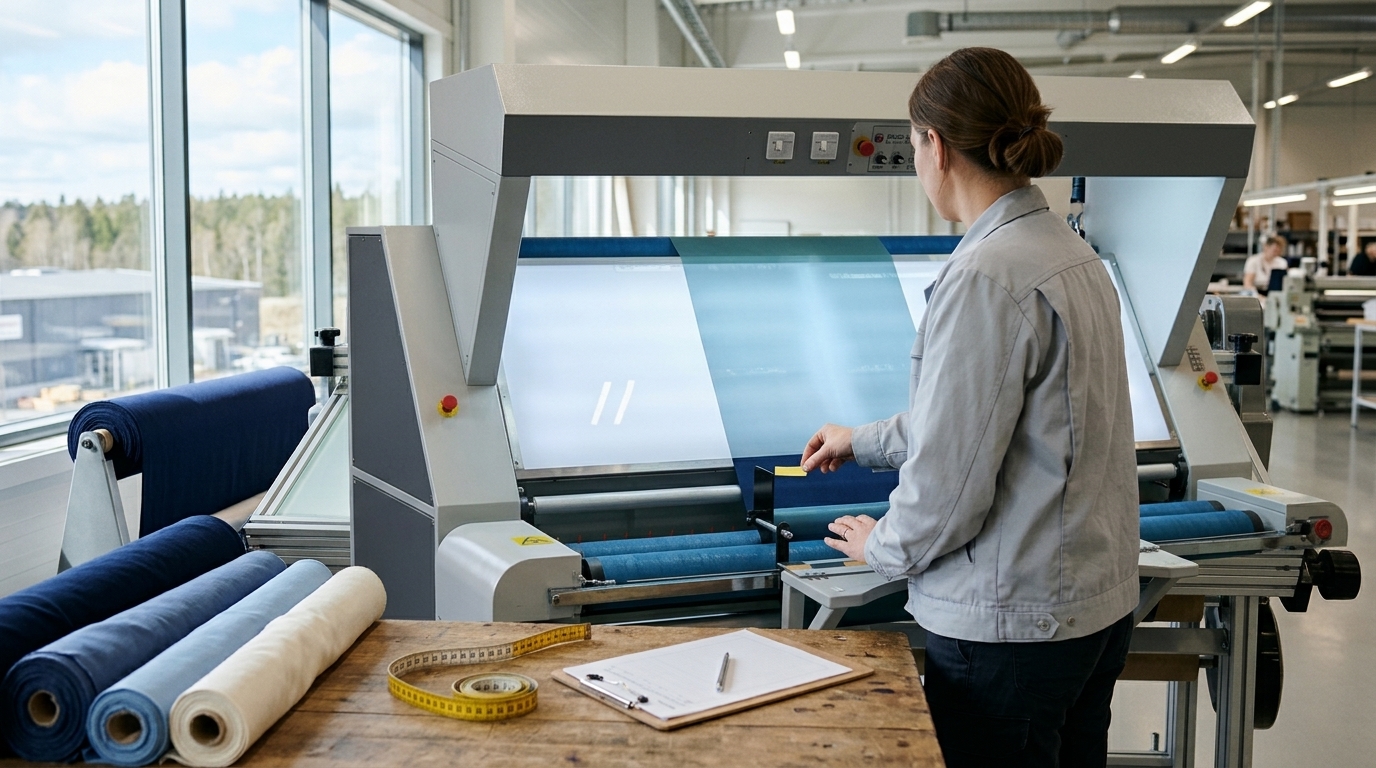
Speed matters, but faster is not always better. Manual inspection usually moves at an effective 5 to 12 metres per minute, according to Shelton Vision’s managing director in Imaging and Machine Vision Europe. Push much faster, and the inspector’s eye starts to miss fine flaws.
That is why variable speed matters more than top speed. Your team can slow down for delicate or patterned fabric, then speed up to rewind a roll once it has been checked. Svegea’s economy inspection machines, for example, run from 0 to 45 metres per minute, while the CMI 210 R reaches 50, all with electronic speed control.
Which features matter most?
Beyond speed, five features decide how well a machine works day to day:
- Edge alignment. A photocell keeps the fabric edge straight, so rolls rewind neatly and spread more easily later.
- Tension control. Knits and stretch fabrics distort under pull. Adjustable tension lets them run without stretching, so the length you measure is the length you get.
- A reliable counter. An electronic metre counter records the exact length of every roll.
- Working width. Choose a machine that fits your widest fabric. Common working widths run from 1,800 mm to 2,100 mm.
- Operation mode. Roll-to-roll suits most woven and knit fabric. Roll-to-flat lays the fabric flat instead, which helps with goods that crease or crush.
Good lighting and a clear inspection surface also help. After all, inspectors can only flag what they can see.
How do you check a roll’s true length and width?
Every roll arrives with a label, and labels are not always right. A machine with a counter turns inspection into a free length check: run the roll, compare the counter with the label, and note any gap.
Width deserves the same attention. Measure it at the start, middle and end of each roll, because fabric that narrows halfway can wreck a marker plan. When these numbers are recorded for every roll, short or narrow deliveries are spotted before invoices are paid.
This habit pays off twice. Brands preparing for the EU’s Digital Product Passport will increasingly ask suppliers for exactly this kind of roll data.
How do you grade the defects you find?
Most garment factories use the 4-point system, set out in the ASTM D5430 standard. Each defect earns 1 to 4 penalty points based on its size:
- Up to 3 inches: 1 point
- Over 3 and up to 6 inches: 2 points
- Over 6 and up to 9 inches: 3 points
- Over 9 inches: 4 points
The points are then converted into a score per 100 square yards of fabric:
Points per 100 sq yd = (total points × 36 × 100) ÷ (fabric width in inches × roll length in yards)
For example, a 120-yard roll that is 45 inches wide with 22 points scores about 14.7. According to V-Trust, some factories accept up to 40 points per 100 square yards, although many buyers set a stricter limit.
Which machine fits your factory?
Match the machine to your volume and fabric mix, not to the biggest number on a brochure. A smaller workshop that handles mostly woven fabric up to 1.8 metres wide may only need a simple roll-to-roll model with a yard counter, such as Svegea’s CMI 180. Factories running knits, wide fabrics or mixed orders gain more from photocell edge alignment, electronic tension and a metre counter, which come standard on the 2.1-metre CMI 210 R and CMI 210 ZR.
Whatever you choose, ask to see the machine run your own fabric. A demo with your toughest roll tells you more than any spec sheet.
Frequently asked questions
How fast should a fabric inspection machine run?
Most economy machines offer variable speed up to about 45 to 50 metres per minute. Manual inspection is usually effective at 5 to 12 metres per minute, so slow down for detailed checks and speed up for rewinding.
What features should a fabric inspection machine have?
Look for variable speed, photocell edge alignment, adjustable tension, an accurate metre or yard counter and a working width that fits your widest fabric.
What is the 4-point system in fabric inspection?
It is a grading method under ASTM D5430. Each defect gets 1 to 4 points based on its length, and the roll is scored per 100 square yards.
How many points per 100 square yards is acceptable?
Some factories accept up to 40 points per 100 square yards, but buyers often set stricter limits in their contracts.
Can a fabric inspection machine measure roll length?
Yes. Machines with a metre or yard counter record the true length of each roll as it runs, so you can compare it with the supplier’s label.
Catch it on the roll
Short runs leave no room for surprises. The best inspection routine finds them on the roll, long before the scissors come out.
See it run your fabric
Want to see how a Svegea inspection machine handles your fabric? Contact Svegea of Sweden or email Hakan Steene at h.steene@svegea.se to book a product demo.