
Autumn is creeping back in, and with it, the trench coat is coming out of storage again. Scroll through any fashion feed right now and you’ll see it: belted, oversized, thrown over a slip dress or buttoned up over a suit. It never really goes away, but every September it seems to reintroduce itself as the season’s must-have layer.
We’ve watched this coat cycle through fashion for years from our side of the industry — the manufacturing side. And here’s the thing most style articles won’t tell you: the reason a good trench coat still looks sharp after a decade of wear has almost nothing to do with the belt or the buttons everyone photographs. It’s buried inside the collar, the lapel, and the lining, in a set of narrow fabric strips most wearers never think about.
A Coat Built Like a Small Structure
Thomas Burberry patented gabardine back in 1879, engineering it specifically to be waterproof without the stiffness of rubberized rainwear. That original goal — weather resistance without bulk — is still what separates a real trench coat from a coat-shaped raincoat. But weatherproof fabric alone doesn’t explain why a well-made trench holds its collar stand or keeps its lapels from curling after years of use.
That comes down to internal reinforcement: collar stays, lapel interlining, and the strapping used for belts and epaulettes. Unlike a lightweight dress or blouse, a trench coat carries real structural weight. Heavy gabardine, dense twill, sometimes multiple bonded layers — none of it behaves the way thin fabric does under a sewing machine, and none of it forgives sloppy internal construction.
So while the outer fabric gets all the design credit, it’s these hidden strips of interlining and tape that decide whether the coat ages gracefully or starts sagging at the shoulders by its second winter.
What Those Hidden Strips Actually Do
A few things happen when a manufacturer gets this part right:
- The collar stands up crisply instead of collapsing, even on a heavy double-layered lapel.
- Belt loops and cuff straps stay straight and don’t twist over time.
- The fabric doesn’t fray internally where it’s under the most tension — shoulders, waist, collar edge.
- The coat keeps its shape wash after wash, season after season.
None of this shows up in a product photo. You notice it later, the first time you flip your collar up against a cold wind and it actually stays put.
Where Hand-Cutting Runs Out of Road
A skilled tailor working on a single bespoke coat can cut collar stays and waist strapping by hand, with shears and a steady eye. It works, at that scale.
It doesn’t work at factory scale. Once a manufacturer is producing thousands of coats a season, hand-slitting heavy rolls introduces the kind of inconsistency that ruins a production run: frayed edges from blade friction, strips that come out a millimeter or two off-width, automated sewing lines thrown out of alignment because the input material isn’t uniform. Multiply a small error by ten thousand units and it stops being small.
This is the point where most outerwear manufacturers move to dedicated slitting equipment. And it’s the part of the process we spend most of our time thinking about.
Where We Come In
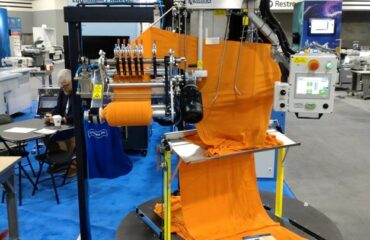
At Svegea, we build roll slitting and band cutting machines designed around exactly this problem: cutting dense, heavy fabric into narrow, consistent strips without the fraying, stretching, or width drift that ruins a production batch.
A few things our machines are built to handle:
1. Consistent width across the whole roll. The strip you cut at meter one should match the strip at meter one thousand.
2. Clean edges on dense material. Automatic blade sharpening keeps friction and heat from fraying heavier fabrics like gabardine or bonded interlining.
3. Tension control that doesn’t distort the weave. Heavy woven fabric under the wrong tension stretches unevenly, and that shows up later as puckering.
We didn’t design this equipment with trench coats specifically in mind — it’s used across tailored blazers, technical rainwear, and industrial textiles too — but outerwear is where the margin for error is smallest. Dark, structured coats show every flaw in daylight.
The Part Nobody Photographs
There’s a reason this kind of detail rarely makes it into a fashion write-up. It’s not glamorous. Nobody’s Instagramming a roll of interlining tape. But it’s the difference between a coat that’s still in rotation a decade from now and one that’s in a donation bag by next spring.
If you’re on the manufacturing side and dealing with fraying, width inconsistency, or waste on heavy-fabric roll slitting, it’s worth a conversation — we’ve spent a long time solving exactly this problem. You can reach our engineering team through svegea.se, or explore the equipment lineup on the same site.
Either way, next time you flip up a trench coat collar against the wind, you’ll know what’s actually holding it there.