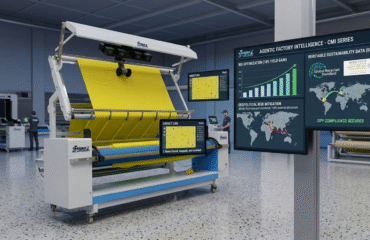

Manual cutting introduces variability that compounds across every shift. PLC-controlled systems eliminate that variability by automating the decisions your operators currently make by feel. The result: consistent rolls, less waste, and a cutting room that runs the same way at 6 AM as it does at midnight. This guide walks you through each stage of the upgrade — from auditing your current setup to keeping your new system running at peak performance.
Why Manual Cutting Is Costing You More Than You Think
Every garment manufacturer knows the frustration: two operators running the same machine produce slightly different results. One pulls the fabric a little tighter. Another doesn’t notice a blade drifting. By the end of a shift, you’ve accumulated inconsistencies that show up as waste, rework, and quality rejections downstream.
The root problem isn’t the operators, it’s the process. Manual cutting asks humans to maintain machine-level precision across hours of repetitive work. That’s not a reasonable ask, and the data reflects it. Tension variations, misaligned rolls, and angle drift are normal outcomes of manual systems, not exceptions.
A Programmable Logic Controller (PLC) changes the equation. PLCs execute the same logic on every cycle — no fatigue, no interpretation, no variation between shifts. They read inputs from sensors, process them against programmed parameters, and trigger outputs like motors, clamps, and cutters in exact sequence. For textile cutting, this means consistent fabric tension, repeatable cut angles, and rolls that come out identical whether you’re producing your first batch of the day or your fiftieth.
Factories that make this transition typically see waste reduction of up to 20% and throughput improvements of around 30%. The investment pays back in quality and output, but only if the upgrade is done properly.
Step 1: Audit Your Current Cutting Room
Before you specify a single piece of hardware, spend a week documenting what’s actually happening on your floor.
What to measure:
- Roll width consistency across operators and shifts
- Tension readings at various points in the fabric feed
- Cut angle accuracy for bias operations
- Machine downtime and error frequency
- Scrap rates by fabric type
Use tension meters and calipers to get hard numbers. Don’t rely on operator memory or visual estimates — you need a baseline you can measure your improvement against.
For tubular knit operations, pay particular attention to how the fabric behaves as it’s opened and fed. Bunching, skewing, and uneven tension are common pain points that PLC integration addresses directly. For bias cutting, log how frequently angle drift occurs and how operators currently correct for it.
Set specific improvement targets before you move forward. A goal like “achieve less than 1mm variance across 50 consecutive rolls” gives your engineering team something concrete to design and test against. Budget realistically: PLC hardware for a textile cutting application typically runs $5,000–$20,000, depending on the scale and complexity of your operation.
Step 2: Choose the Right PLC Hardware
PLC selection depends on how many sensors and actuators your cutting process requires. For most textile cutting applications, you’re looking at a mid-range controller with 16 or more digital inputs (for sensors) and 12 or more outputs (for motors, pneumatics, and actuators).
For the cutting machinery itself, look for equipment designed specifically for textile applications — machines built to handle the tension characteristics and material behavior of woven and knit fabrics. Svegea’s Tubular Knit Slitter TSO 380, for example, is purpose-built to open tubular knit fabric into flat rolls with integrated tension control, and it’s designed to pair with PLC automation. Their Bias Cutter CMB 1800 handles widths up to 1800mm at adjustable angles between 30° and 60°, making repeatable bias cuts practical at production scale.
A few practical hardware considerations:
- IP-rated enclosures are essential in cutting rooms where fabric dust is a constant presence
- Servo motors give you the precise feed control that stepper motors can’t match
- Industrial-grade sensors — not consumer components — hold calibration under production conditions
Step 3: Design Your Sensor Integration
Sensors are the eyes of a PLC system. Without accurate, reliable sensor input, your programmed logic has nothing useful to act on.
For fabric position detection, capacitive sensors work well — they detect material presence without contact, which matters for delicate or stretchy knits. Mount them at feed entry and exit points so the PLC knows exactly where the fabric is at each stage of the process.
For bias cutting applications, rotary encoders on the cutter mechanism give the PLC continuous feedback on blade angle. This allows the controller to make real-time adjustments rather than relying on a fixed mechanical setup that can drift over time.
A typical automated cutting sequence looks like this:
- Fabric feeds along the conveyor
- Position sensor detects material alignment
- PLC signals the conveyor to stop
- The pneumatic clamp extends to secure the fabric
- Cutter activates for the programmed duration
- Clamp retracts, conveyor resumes
- Fault detection checks the output; rejects bad rolls automatically
Use shielded cables throughout. Electrical noise from motors is the most common cause of sensor signal interference in factory environments, and it’s much easier to address during installation than after.
Step 4: Write the PLC Logic
Ladder logic is the standard programming language for PLC systems, and it’s worth understanding the structure even if your engineers handle the implementation.
Start with the simplest possible version of your cutting sequence: sensor input stops conveyor, cutter motor activates, timer controls duration, cutter deactivates, conveyor resumes. Get that working reliably before adding complexity.
From there, build in:
- Counters for batch tracking — know how many rolls have been cut without manual counting
- Fault detection routines — define what an out-of-spec output looks like and what the system should do when it detects one
- HMI parameter screens — operators should be able to adjust cut length, speed, and batch size without touching the underlying code
- PID loops for speed control — these continuously correct motor speed to maintain consistent fabric tension
For bias cutting specifically, the logic needs to account for angle changes between product runs. Program angle positions are named presets rather than raw values, so operators can switch between them without error.
Simulate your logic in software before uploading it to the controller. Siemens TIA Portal includes simulation tools; most major PLC platforms have equivalents. Catching logic errors in simulation is far less costly than catching them during a live test with fabric running.
Step 5: Install, Calibrate, and Test
Plan your installation around a scheduled maintenance window. The “hot-cutover” approach — backing up your existing logic, swapping hardware, and restoring operations quickly — minimizes production disruption.
Once wired and powered, run the system dry (no fabric) to verify that every sensor triggers correctly, every actuator responds on cue, and fault conditions behave as programmed. Then move to sample runs.
For your initial fabric tests:
- Run at least 50 consecutive rolls before evaluating consistency
- Measure each roll for width, tension, and cut quality
- Target less than 1mm variance as your acceptance threshold
- Document any deviations and adjust PID parameters accordingly
Expect to spend time in this tuning phase. PID loop calibration for fabric feed is iterative — you’re finding the control parameters that balance responsiveness with stability for your specific materials. Tighter, stiffer fabrics behave differently from open knits, and your parameters should reflect that.
Log everything during testing. If a fault pattern emerges, you want the data to diagnose it.
Step 6: Train Your Team Properly
A PLC system is only as reliable as the people who operate and maintain it. Rushed training leads to workarounds that undermine the consistency you installed the system to achieve.
Operators need to know how to:
- Navigate HMI screens to set and adjust parameters
- Recognize and respond to fault alerts
- Perform basic sensor checks
- Know when a problem requires an engineer vs. when they can resolve it themselves
Engineers need to know how to:
- Access and interpret system logs
- Make ladder logic edits for parameter changes or minor process adjustments
- Troubleshoot sensor and actuator faults
- Perform firmware updates safely
Vendor training programs are worth the investment. Certified operators and engineers handle problems faster, make better decisions under pressure, and are less likely to introduce errors during routine adjustments.
Step 7: Build a Maintenance Routine
PLCs are durable, well-maintained systems that run for years without major issues. But “well-maintained” requires actual scheduled attention, not just responding to problems when they occur.
Quarterly minimum:
- Clean all sensors (fabric dust accumulation degrades signal reliability)
- Inspect wiring and connectors for wear or looseness
- Review and update firmware
- Check and recalibrate tension settings against your baseline measurements
Ongoing:
- Track KPIs — waste per shift, uptime percentage, fault frequency
- Review system logs monthly to catch drift before it becomes a problem
- Set up remote monitoring via Ethernet if your infrastructure supports it; the ability to check system status without being on the floor pays off quickly
Treat your PLC documentation as a living document. When parameters change, when logic is updated, when sensors are replaced — record it. Institutional knowledge stored only in people’s heads disappears when those people move on.
What This Means in Practice: Tubular Knits and Bias Cutting
Two cutting operations benefit especially dramatically from PLC automation.
Tubular knit slitting requires opening circular knit fabric into a flat roll without introducing tension inconsistencies that distort the material. Manual operation is sensitive to operator technique — too much tension changes the fabric’s stretch characteristics; too little leads to misalignment. A PLC-controlled slitter like the Svegea TSO 380 maintains consistent tension automatically across the full roll width, producing flat fabric that’s ready for the next production stage without manual correction.
Bias cutting produces the stretchy binding tape used at garment edges, necklines, and seams. The challenge is maintaining a precise, consistent angle — typically between 30° and 60° to the grain — across long production runs. Angle drift in manual bias cutting can result in binding tape that’s either too stretchy or too stiff, neither of which works reliably in sewing. PLC control eliminates angle drift, and with encoder feedback, the system can verify and correct angle position in real time.
In both cases, the output isn’t just more consistent — it’s more useful downstream. Sewing lines that receive consistent input material run faster, require fewer adjustments, and produce fewer defects.
Getting Started
The most important first step is the audit. Before evaluating hardware or writing a specification, you need an honest picture of where your current process falls short and what improvement actually looks like in measurable terms.
From there, the upgrade is a structured engineering project — not a leap of faith. PLC integration in textile cutting is well-understood, and the path from manual to automated operation is well-documented.
For questions about integrating PLC automation with your cutting equipment, contact Håkan Steene at h.steene@svegea.se.