Profit margins in the textile industry often depend on the smallest details. In a high-volume garment factory, every centimeter of fabric and every second of labor counts toward the bottom line. As we move through 2026, CFOs and procurement officers are looking beyond the initial price tag of machinery. They are now focusing on a more critical metric: Textile slitting machine ROI.
While manual slitting has traditionally kept upfront costs low, it often hides “invisible” expenses that erode profitability. In contrast, automated systems provide a path toward altruistic manufacturing—where efficiency and worker well-being go hand-in-hand. This guide breaks down the financial logic of upgrading your cutting room.
TL;DR: The Financial Impact of Automation
-
- Direct Savings: Automated slitting reduces fabric waste by an average of 15% through precision edge-sensing.
- Labor Efficiency: One automated system typically replaces the output of three manual stations, reallocating labor to higher-value tasks.
- The ROI Formula: Annual Savings = (Manual Labor Cost + Waste Value) – (Automated Labor Cost + Maintenance).
- Payback Period: Most high-volume manufacturers achieve full ROI within 12 to 18 months.
The Hidden Costs of Manual Slitting
Many manufacturers view manual slitting as a flexible, low-risk operation. However, human variability introduces financial leaks that are difficult to track without granular data. Manual operators, regardless of their skill level, experience fatigue. This leads to inconsistent roll tension and slight cutting deviations.
When a roll is slit inaccurately, the downstream effects are costly. Inconsistent widths cause jamming in sewing machines or misaligned seams in the final garment. According to the World Textile Information Network (WTIN), quality-related rejects can cost a factory up to 5% of its annual revenue. By switching to a system with automated tension control, you essentially “plug” these financial leaks.
Quantifying the Efficiency Gap: Manual vs. Automated
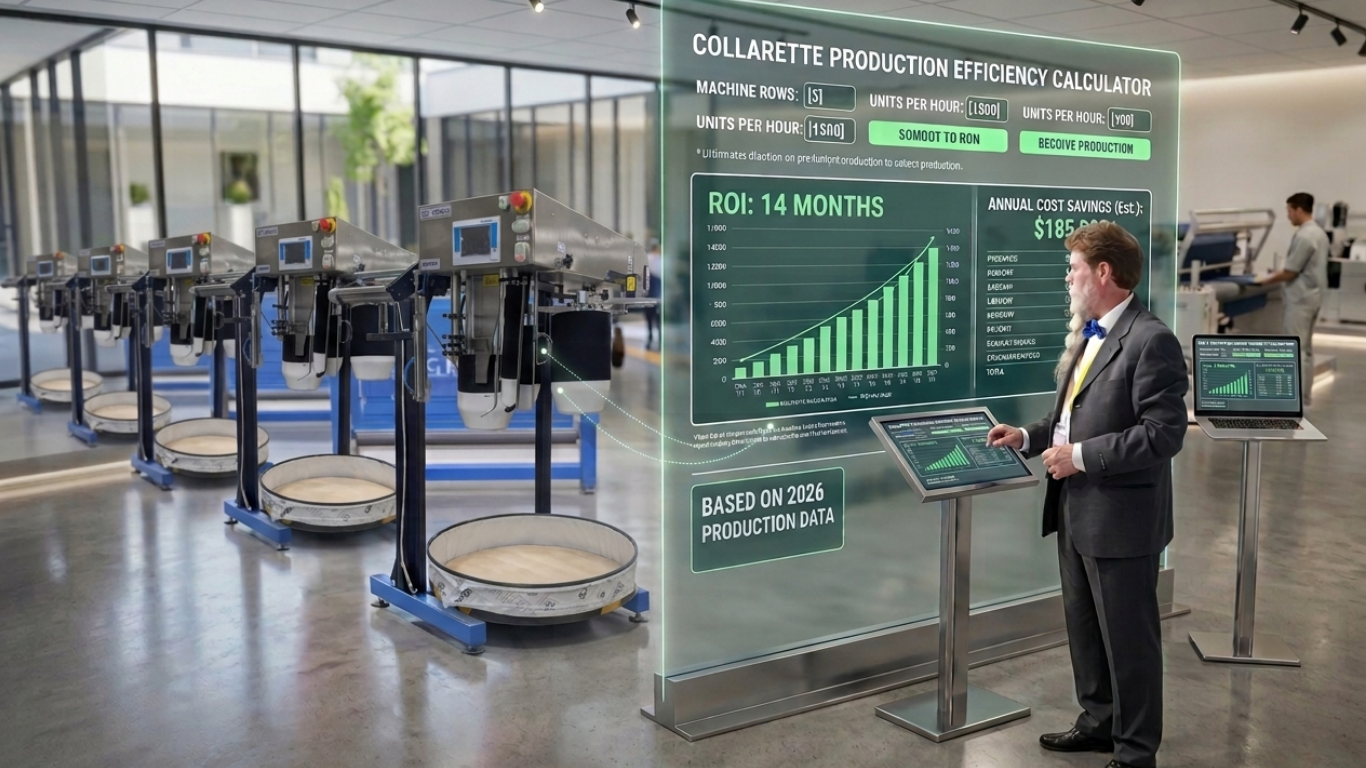
To understand the textile slitting machine ROI, we must look at the hard data. Below is a comparison based on standard 2026 production metrics for mid-to-large-scale garment facilities.
| Metric | Manual Slitting Operation | Automated Slitting (Svegea) |
| Output per Hour | 40 – 60 Meters | 150 – 250 Meters |
| Material Waste % | 18% – 22% | 3% – 5% |
| Operator Hours | 3 Operators | 1 Technician |
| Rejection Rate | Moderate (4%+) | Minimal (<1%) |
| Safety Risk | High (Manual blades) | Low (Enclosed PLC) |
The table illustrates that automation isn’t just about speed. It is about the drastic reduction in material waste. In an era where fabric costs represent nearly 60% of the total garment cost, a 15% reduction in waste directly impacts the gross margin.
A “Plug-and-Play” ROI Formula for CFOs
Calculating the return on investment doesn’t have to be a complex task. You can use this simplified formula to estimate your potential annual savings:
Total Annual Savings = [(Lh × Rh) + (W% × Fm)] – Am
- Lh: Reduction in manual labor hours per year.
- Rh: Hourly labor rate (including benefits).
- W%: Percentage of fabric saved through precision cutting.
- Fm: Total annual fabric spend.
- Am: Annual maintenance and power cost of the new machine.
For example, a factory spending $1M annually on fabric that reduces waste from 15% to 5% saves $100,000 on material alone. When you add the reduction in labor hours, the machine often pays for itself in just over a year.
Sustainability as a Financial Asset
The International Finance Corporation (IFC) highlights that resource efficiency is now a core requirement for textile financing and global trade compliance. Automated slitting supports this by ensuring “Right-First-Time” production.
Beyond the immediate cash flow, automated systems help factories align with the UN Sustainable Development Goals for responsible consumption and production. For a CFO, this means better access to “green” credit lines and more robust partnerships with global brands that prioritize audited, sustainable supply chains.
Featured Tech: The Svegea EC-300 Collarette System
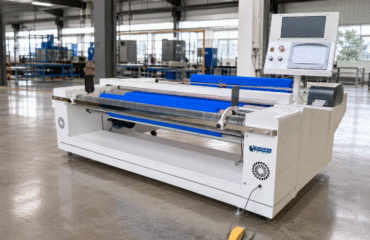
The Svegea EC-300 serves as a benchmark for this financial transition. It is not just a cutter; it is a profit-recovery tool. Designed with an advanced PLC (Programmable Logic Controller), it allows for rapid changes in slitting widths with zero downtime.
What makes the EC-300 a strategic choice is its durability. High-quality Swedish engineering ensures that the machine maintains its precision over a decade of use, rather than degrading after a few years. This longevity is a key factor in calculating the long-term textile slitting machine ROI. It allows procurement officers to amortize the cost over a longer period, improving the balance sheet.
The Human Element: An Altruistic Transition
Investment in automation is often misinterpreted as a move to eliminate the workforce. However, leading manufacturers are using automation to solve the “Labor Gap.” Finding skilled manual cutters is increasingly difficult.
By implementing automated slitting, you provide your employees with a safer, tech-forward environment. This reduces turnover and training costs—another “soft” ROI factor that often goes uncounted. Workers transition from physically demanding roles to managing sophisticated PLC systems, which increases their own professional value within the industry.
Moving Forward with Data
The decision to upgrade your cutting room should be based on transparency and data. In the current market, the cost of doing nothing—and continuing with manual waste—is often higher than the lease payment on a new, automated system.
By analyzing your current waste percentages and labor hours, you can create a customized roadmap for your factory’s evolution. Automation is the bridge between the traditional craft of garment making and the high-efficiency requirements of the modern world.
Evaluate Your Cutting Room Today
Maximizing your ROI requires a blend of the right technology and strategic planning. If you are ready to move from manual estimates to automated precision, professional insight can help you bridge the gap.
For a detailed ROI analysis or technical specifications, please contact Håkan Steene at h.steene@svegea.se.