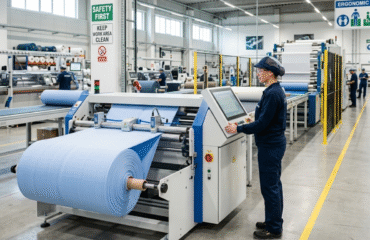
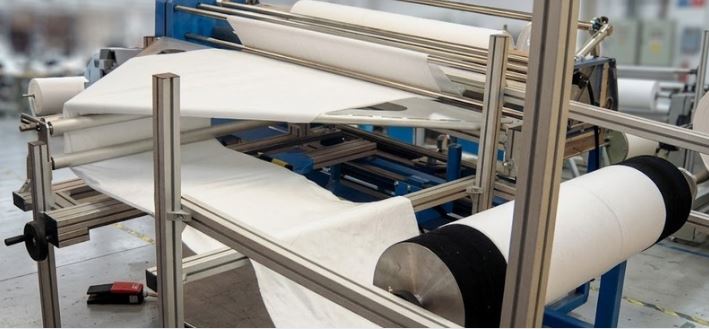
Every plant manager has seen it: a sewing room fully staffed and ready, sitting idle because the fabric hasn’t arrived. It is tempting to blame scheduling or a slow supplier. However, the real bottleneck often sits a few steps earlier, where the tubular knit fabric gets processed before it ever reaches a cutting table. Tubular fabric processing covers everything from opening the knitted tube to slitting it into usable widths. Small inefficiencies at this stage multiply quickly as material moves downstream toward the sewing floor.
TL;DR Most throughput problems in garment manufacturing do not start in the sewing room. They start upstream, where workers open, slit, and prepare tubular knit fabric. Manual trimming, fabric tension, oversized waste margins, and slow changeovers are the usual suspects. Spotting them early protects both your yield and your schedule.
When Manual Trimming Adds Up
Many factories still rely on operators to guide, align, or trim tubular fabric by hand. It works until a shift runs long. Hand-eye coordination drifts after several hours of repetitive cutting. Even a skilled operator will produce slightly uneven widths by the end of a run. Those small variances do not disappear on their own. They later resurface as rejected panels or non-compliant bindings, and a quality control inspector calculates exactly what got wasted and why.
Why Knit Fabric Pushes Back During Slitting
Tubular knit fabric is not a flat, stable material to begin with. Its interlocking loops hold tension from every stage it has already passed through, including knitting, dyeing, finishing, and winding. When a machine pulls fabric too hard or unevenly during slitting, the material stretches along its length. Once the fabric relaxes, it shrinks back unevenly and distorts the panel or binding strip that an operator just cut moments earlier.
This is not a minor technicality that only matters in a lab. Research documents that knitted structures are more prone to dimensional instability than woven fabric, partly because of loop distortion and partly because tension builds unevenly across a roll during production. This stored tension is also why relaxation shrinkage shows up later in finished garments. Fabric only releases the strain introduced during manufacturing once someone cuts, washes, or handles it. For garment manufacturers, this means the slitting stage must manage tension actively. Simply pulling fabric through as fast as possible is not a viable long-term strategy.
The Waste Hiding in Wide Trim Margins
When a slitting line cannot track the edge of a tubular knit precisely, managers usually widen the safety margin. It is a reasonable instinct: cut a little extra so nothing falls out of tolerance. But that margin adds up fast across a full production run. Industry estimates put cutting-room waste at roughly 10 to 15 percent of fabric used in garment production, even under careful planning conditions (bren.ucsb.edu). On high-volume tubular lines, a wider trim margin multiplied across thousands of meters is not a rounding error. It represents real fabric cost, and tighter, more consistent edge tracking can eliminate much of it.
Changeovers and the Domino Effect on the Floor
Few factories run a single fabric width all day. Switching between garment sizes or contract specifications usually means stopping the line, manually adjusting cutting widths, and restarting—a job that takes 30 to 45 minutes each time. Multiply that across a few changeovers per shift, and a meaningful chunk of the working day disappears before a single meter is actually cut.
The problem compounds further when factories run slitting and the next process—like collarette or binding cutting—as separate, disconnected steps. Workers then move rolls by hand between stations, adding handling time and a real risk of transport damage or distortion before the fabric is even put to use.
Where to Start an Audit
Where should an audit actually start? A few mechanical questions tend to surface most of the issues above:
-
Edge Tracking: Does the slitter track the fabric edge automatically, or does it still depend on an operator’s eye and a steady hand?
-
Tension: Is fabric fed under controlled, even tension, or is it simply pulled through at whatever speed the line happens to be running?
-
Setup Speed: Can you make width changes within a couple of minutes, or does every changeover mean a near-total teardown of the cutting head?
What Better Tubular Processing Looks Like
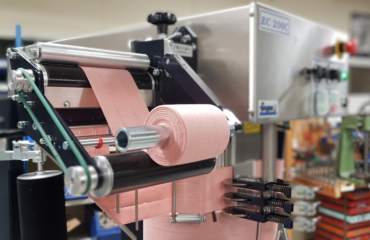
Machines purpose-built for tubular knit slitting offer a useful reference point for what addressing these questions looks like in hardware. Svegea’s Tubular Knit Slitter – TSO 380 G/GF, for example, features photocell edge alignment instead of manual guiding. It includes an automatic prefeed device that controls tension right ahead of the cutting blade. It is also electronically controlled and runs at speeds up to 30 meters per minute.
None of this is a cure-all, and no single machine will fix a workflow problem on its own. The point is simply that tension control, edge tracking, and changeover speed are the same engineering questions worth raising about any tubular processing setup, regardless of who built it.
TL;DR Tubular fabric processing rarely fails all at once. Instead, it leaks margin gradually through hand trimming, fabric tension, wide safety cuts, and slow changeovers. Auditing edge tracking, tension control, and changeover time is a reasonable first step before assuming you need new equipment.
Stop Leaking Fabric Margin—Optimize Your Cutting Floor Today
Don’t let manual trimming and uneven tension quietly drain your factory’s profitability. If you’re ready to eliminate cutting-room bottlenecks, reduce waste, and keep your sewing lines running at peak capacity, let’s look at the numbers together.
Get expert technical guidance tailored to your specific production setup. Contact Håkan Steene directly at (h.steene@svegea.se) now to schedule a consultation, or visit our product pages to see how automated tracking can transform your floor.