Key Takeaway:
Not all slitting machines are built the same. Swedish manufacturing standards prioritize precision, durability, and long-term efficiency over short-term cost savings. For garment and textile producers, the right machine reduces fabric waste, improves cut consistency, and lowers the total cost of ownership. This article breaks down what separates high-quality slitting machines from cheaper alternatives—and why it matters to your bottom line.
Every roll of fabric that moves through your production line carries a cost. A clean, precise slit keeps that cost under control. A poor one bleeds money through waste, rework, downtime, and inconsistent output. For garment and textile manufacturers, the choice of a slitting machine is not a minor procurement decision. It’s an operational one.
The global market for textile machinery is crowded. Budget machines from low-cost manufacturing regions flood industry catalogs. They look functional on a spec sheet. But over months and years of production, the gap between engineered quality and engineered cheapness becomes very clear.
So what makes a slitting machine genuinely good? And why does Swedish engineering, in particular, continue to set the benchmark?
The real cost of precision—or the lack of it
Slitting machines are responsible for cutting fabric rolls into specific widths. The cut has to be straight, consistent, and clean. Even small deviations compound quickly at scale. A 1mm variance across a 200-meter roll can mean thousands of unusable centimeters of material.
According to the World Trade Organization, textiles and apparel represent one of the world’s largest manufacturing sectors. Margin pressure is relentless. In that environment, fabric waste is not just a technical problem—it’s a financial one.
High-quality slitting machines solve this with tight engineering tolerances, stable cutting heads, and reliable edge guidance systems. Cheaper machines cut corners—literally and figuratively. The result is more trim waste, more operator intervention, and more downtime for adjustments.
What Swedish engineering actually means
Sweden has a long industrial heritage built around precision manufacturing. Industries like aerospace, automotive, and medical devices have shaped a manufacturing culture that treats quality as non-negotiable. That culture carries directly into textile machinery.
Swedish manufacturers are held to strict standards under ISO 9001 quality management frameworks, meaning design, production, and testing processes are documented and audited. This matters when you’re buying a machine that will run shifts day in and day out for years.
The difference shows up in material selection, component tolerances, weld quality, motor performance, and software control. It also shows up in after-sales support—the ability to get parts, get answers, and get back to production when something goes wrong.
Semi-automatic vs. fully automatic: choosing what fits your operation
Not every factory needs the same solution. One of the more practical distinctions in slitting machine selection is automation level.
Semi-automatic machines offer flexibility for operations that run varied roll formats or smaller batch sizes. The operator is more involved in setup, which can actually be an advantage when you’re working with diverse fabric types—delicate knits, woven materials, non-wovens, and technical textiles each behave differently under the blade.
Fully automatic machines are built for volume. Once configured, they minimize operator input, maximize throughput, and reduce the human error factor. For high-production facilities running consistent materials, the productivity gains are significant.
The International Textile Manufacturers Federation (ITMF) tracks global machinery investment trends, and automation consistently ranks among the top priorities for manufacturers seeking competitive advantage.
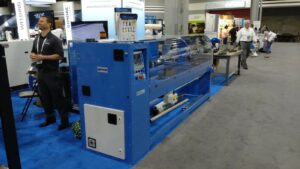
Svegea FA 500 — Fully Automatic Roll Slitting Machine
A heavy-duty, fully automatic machine designed for open knits, woven fabric, PVC, vinyl, satin, polyester, paper products, and non-wovens. Built in Sweden for consistent high-volume performance with adjustable cutting widths and automatic edge guidance.
View technical details at svegea.se →
The hidden costs of buying cheap
A lower upfront price is appealing. It always is. But the total cost of ownership tells a different story.
Cheaper slitting machines typically present hidden costs in three areas. First, replacement parts. Budget machines often rely on proprietary components that are difficult to source, especially from overseas suppliers with slow lead times. Second, unplanned downtime. Less robust construction means more mechanical failures—and every hour a machine is idle is an hour of lost production. Third, quality rejects. Inconsistent cuts lead to unusable fabric, rework, and potential delays in customer delivery.
Research from the McKinsey Global Institute on industrial equipment has consistently shown that total cost of ownership—not purchase price—is the more relevant metric for capital equipment decisions.
A well-built slitting machine, properly maintained, can run reliably for 15 to 20 years. A cheap one may need replacing in five. Over a production lifecycle, the math is rarely close.
Material versatility: not all fabrics are the same
Here is something that often gets overlooked in machinery comparisons: the range of materials a slitting machine can handle cleanly.
Textile production isn’t a single-material industry. A facility may run jersey knit one day and non-woven technical fabric the next. A machine that handles one well but struggles with another creates a bottleneck. Good engineering accounts for this. Adjustable blade tension, variable speed control, and intelligent edge detection systems give operators the control to work across a broad material range without compromising cut quality.
The Textile Exchange Material Benchmark documents the growing complexity of material mixes in modern production. Manufacturers who invest in versatile, adaptable machinery are better positioned to take on diverse orders—and to pivot as market demand shifts.
Sustainability: precision reduces waste
There is an environmental dimension to slitting quality that is increasingly relevant to manufacturers. Fabric waste is material waste. For operations pursuing sustainability certifications or responding to customer pressure on environmental performance, slitting precision is a direct lever.
The Ellen MacArthur Foundation’s work on circular fashion highlights fabric waste as one of the industry’s highest—and most avoidable—environmental costs. A machine that cuts cleanly and consistently is also a machine that wastes less. That matters both commercially and ethically.
Key takeaway
Every millimeter of precision in your slitting process translates to less fabric waste, fewer rejects, and lower operating costs. Engineering quality isn’t an abstraction—it shows up on your P&L.
What to look for when evaluating slitting machines
When assessing slitting machine options, consider the following criteria beyond the sticker price. Build quality and materials used in the frame and cutting mechanism matter enormously for longevity. Precision and repeatability—the ability to maintain consistent cut widths across an entire roll, across every shift—is the core performance requirement. Edge guidance systems that automatically compensate for roll misalignment reduce operator burden and cut quality variance. Motor and drive reliability affect not just performance but noise levels, energy consumption, and lifespan. Finally, after-sales support—parts availability, technical documentation, and direct access to engineers—determines how quickly you can recover from the inevitable maintenance event.
These criteria apply whether you’re evaluating a Swedish machine, a German one, or anything else. The point is to evaluate the total operational value, not just acquisition cost.
Industry associations worth knowing
For manufacturers who want to stay current on textile machinery standards and developments, several industry bodies publish useful resources. CEMATEX (the European Committee of Textile Machinery Manufacturers) represents some of the industry’s most rigorous engineering standards. TMAS (the Textile Machinery Association of Sweden) specifically advocates for Swedish machinery excellence in global markets. Both are worth following for technical developments and trade event updates.
Svegea of Sweden is a member of both associations—a signal of its commitment to industry standards and international quality benchmarks.
Quality is not optional
In a competitive global market, textile manufacturers cannot afford to lose productivity to poorly engineered equipment. Slitting machines sit at a critical point in the production process. The quality of every downstream garment depends, in part, on the precision of that cut.
Swedish engineering brings a philosophy of building things to last, to perform, and to be supported long after the sale. That philosophy has practical consequences for operations that run demanding schedules with unforgiving margin requirements.
The decision is not simply about buying a machine. It’s about investing in production reliability, material efficiency, and long-term operational confidence.
Have questions about slitting machine specifications, material compatibility, or which configuration fits your operation? Reach out directly to Håkan Steene at Svegea of Sweden for a no-obligation conversation.
Contact Håkan Steene — h.steene@svegea.se