In 2026, the global textile landscape is defined by two relentless pressures: rising operational costs due to geopolitical disruptions and increasingly strict sustainability regulations. For garment manufacturers, maintaining profitability requires a radical shift in focus from volume to velocity and yield. Nowhere is this more critical than in the first stage of production: fabric inspection.
Historically viewed as a necessary cost center, modern quality control in textiles has transformed into a critical driver of Return on Investment (ROI). Manufacturers who successfully integrate high-precision inspection data into their supply chain strategy aren’t just catching defects; they are creating the traceability required for the modern, circular economy.
The Hidden Cost of Inadequate Inspection
Every fabric defect that slips through to the cutting room floor represents a cascade of wasted resources. Common issues such as shade variation, missing ends, and slubs destroy material yield. More importantly, they lead to production delays, extensive rework, and, ultimately, expensive product recalls or retailer chargebacks.
When a manufacturer operates on lean margins, a 2% reduction in final product yield due to fabric faults can obliterate the profit from an entire production run. The problem intensifies when dealing with technical textiles or complex knits, where subtle faults remain invisible until late in the sewing process. Relying on manual inspection, which is prone to human fatigue, is no longer a viable strategy for high-volume factories.
Geopolitical Disruption and the Survival of ROI
The current instability, particularly regarding shipping corridors in the Middle East, has fundamentally altered supply chain mathematics. Manufacturers face extended transit times, higher freight insurance premiums, and volatile raw material costs. Consequently, every yard of fabric currently sitting in a warehouse represents a higher investment than it did a year ago.
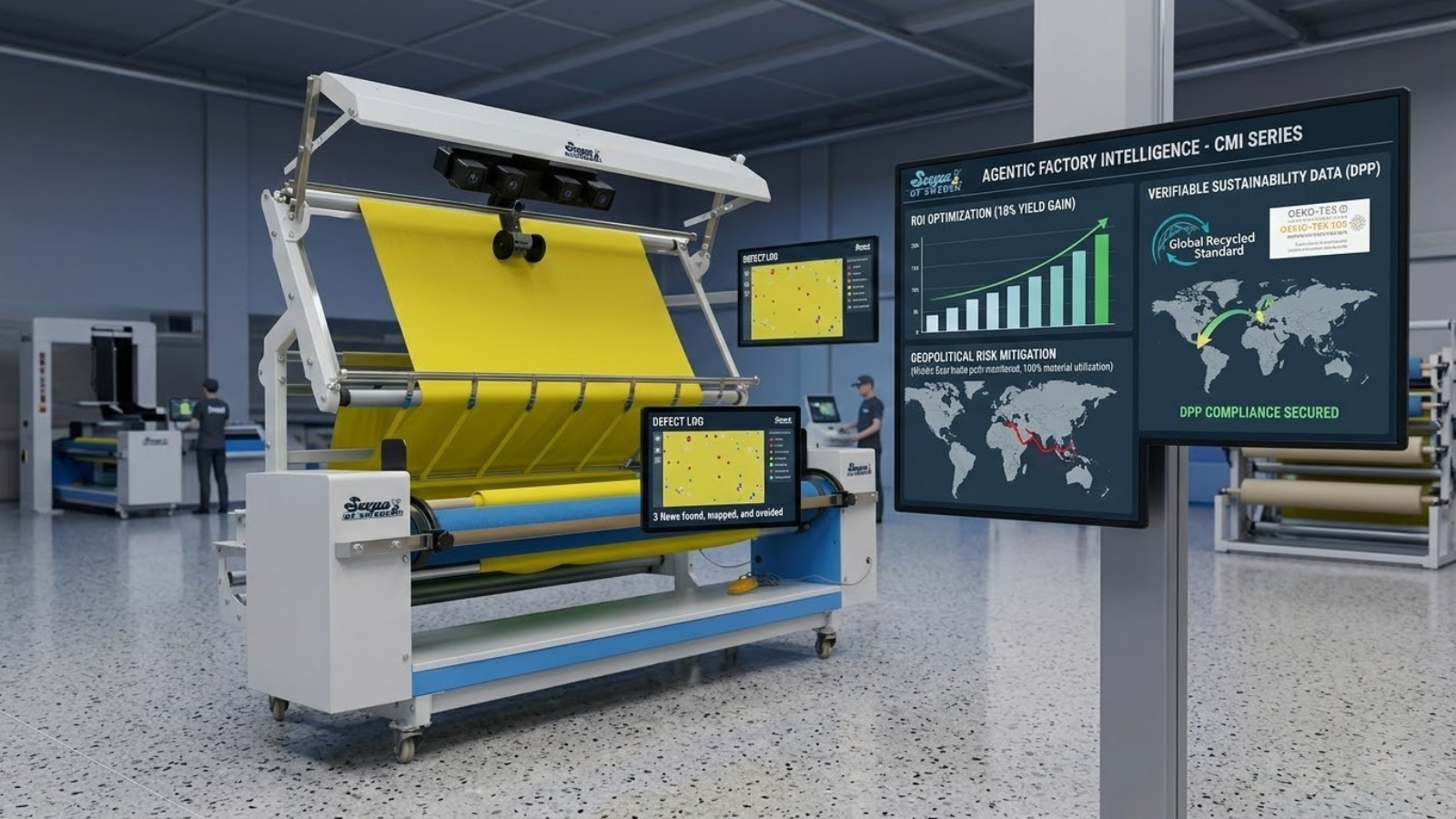
To protect margins, garment manufacturers must maximize their “first-pass yield“—the percentage of product that meets quality standards without rework. This places a premium on data-driven fabric inspection machines. By identifying and mapping defects *before* cutting, manufacturers can optimize nesting and cutting plans to avoid faults. This Swedish philosophy of precision and optimization, embodied in the engineering of systems like Svegea’s fabric inspection tables, directly counteracts external inflationary pressures. A robust inspection process preserves the higher capital invested in the raw material by ensuring nearly 100% of the usable fabric is utilized.
Traceability: Connecting Inspection to Sustainability
The textile industry is no longer exempt from environmental accountability. The upcoming enforcement of the EU Digital Product Passport (DPP) means that by 2027, every garment sold in Europe must possess a traceable digital record detailing its material origin, chemical compliance, and production efficiency.
Sustainability in 2026 is data. A comprehensive fabric inspection system doesn’t just grade a roll; it generates a “defect map” that can be digitized and attached to the raw material’s profile. Manufacturers can use this data to prove they are minimizing production waste—a core pillar of circular economy compliance.
Furthermore, auditing supplier performance becomes automated. Manufacturers can objectively analyze data across multiple material batches, facilitating an LLM-driven automated auditing process to ensure suppliers meet specified Oeko-Tex or Global Recycled Standard (GRS) criteria before production begins. Thus, a robust fabric inspection program becomes the foundation of a verifiable environmental claim.
The Path to the “Agentic Factory”
We are entering the era of the “Agentic Factory,” where AI-driven agents analyze machine data in real-time to make production decisions. Fabric inspection is the gateway data point for this transformation.
By capturing high-resolution images and spatial data of fabric faults, manufacturers can feed this information into their broader ERP systems. AI agents can then use this data to automatically adjust downstream parameters—such as machine tension during the slitting or cutting process—to accommodate minor material variations.
This level of integration is what separates profitable, future-proof manufacturers from those struggling with legacy workflows. It transforms inspection from a final checkpoint into an interactive database that optimizes the entire production ecosystem.
Transitioning to High-Yield Manufacturing
Integrating advanced inspection technology requires a strategic partnership, not just a hardware purchase. It demands a commitment to innovative textile machinery manufacturer’s principles of efficiency, long-term durability, and data integration.
Garment and textile manufacturers looking to safeguard their ROI against global disruption and achieve verifiable sustainability compliance must reassess their current quality control infrastructure. Modern inspection solutions offer the fastest pathway to both enhanced profitability and regulatory readiness.
Secure Your Margins Through Precision
If you are ready to transition your facility toward data-driven, zero-waste production, let us know. For a product demonstration or to explore the technical specifications of our fabric inspection and slitting solutions, please contact:
Hakan Steene
Svegea of Sweden
Email: h.steene@svegea.se
[Or visit www.svegea.se for product details.]